Saturday, 20 January 2018

Hampi - A UNESCO World Heritage Site

Hampi is a tourist attraction in Karnataka, India. It was the centre of Vijayangara dynasty. The word Hampi is derived from Pampa (Parvathy) - Hampe - Hampi. It was the most luxurious city in Asia after Beijing centuries ago. People here lived a life of grandeur and leisure. It was very popular amongst traders of Persia, Portuguese and so on. The city has somehow managed to retain its lush existence under a dusty cover of history, just use your imagination to see it, that was what I did anyway. Note - It is a UNESCO World Heritage Site too. Your interest is piqued, right?
Hampi - Chariot Street & Virupaksha Temple

On our 1st day, in the evening I was roaming about the Virupaksha temple, looking at those pillars, and could almost see a woman in her full glorious attire and hear the onomatopoeic sound of her anklet, playing hide 'n seek with me. I felt if I went behind that pillar I would see her, and she was going to scold me for my baggy khaki trousers and black cropped tee, "Come to my boudoir, I'm gonna teach you how to dress and how to be seductive!" As my mother constantly reminds me not to forget to be a girl!

Inside Virupaksha temple after Sunset

On 2nd day in the morning we went straight to chariot street. It is in front of the Virupaksha temple. While walking through that street with my beau (so much wanted to use that word, at least once in my life, but honestly hate that word!) on my side could imagine the bargaining of the buyers and  shopkeepers, as bargaining is in our Indian DNA, "Give me these brass bangles for 5 mudras, Yashaharini would be waiting for me at the king's balance", "No, no, I can't give them for less than 8 mudras", "Okay, 7", and a lover bought the spring time gift for his beloved, even before Archie's gallery and commercially crazy Valentines' day. 

Ruins outside Vittala Temple complex

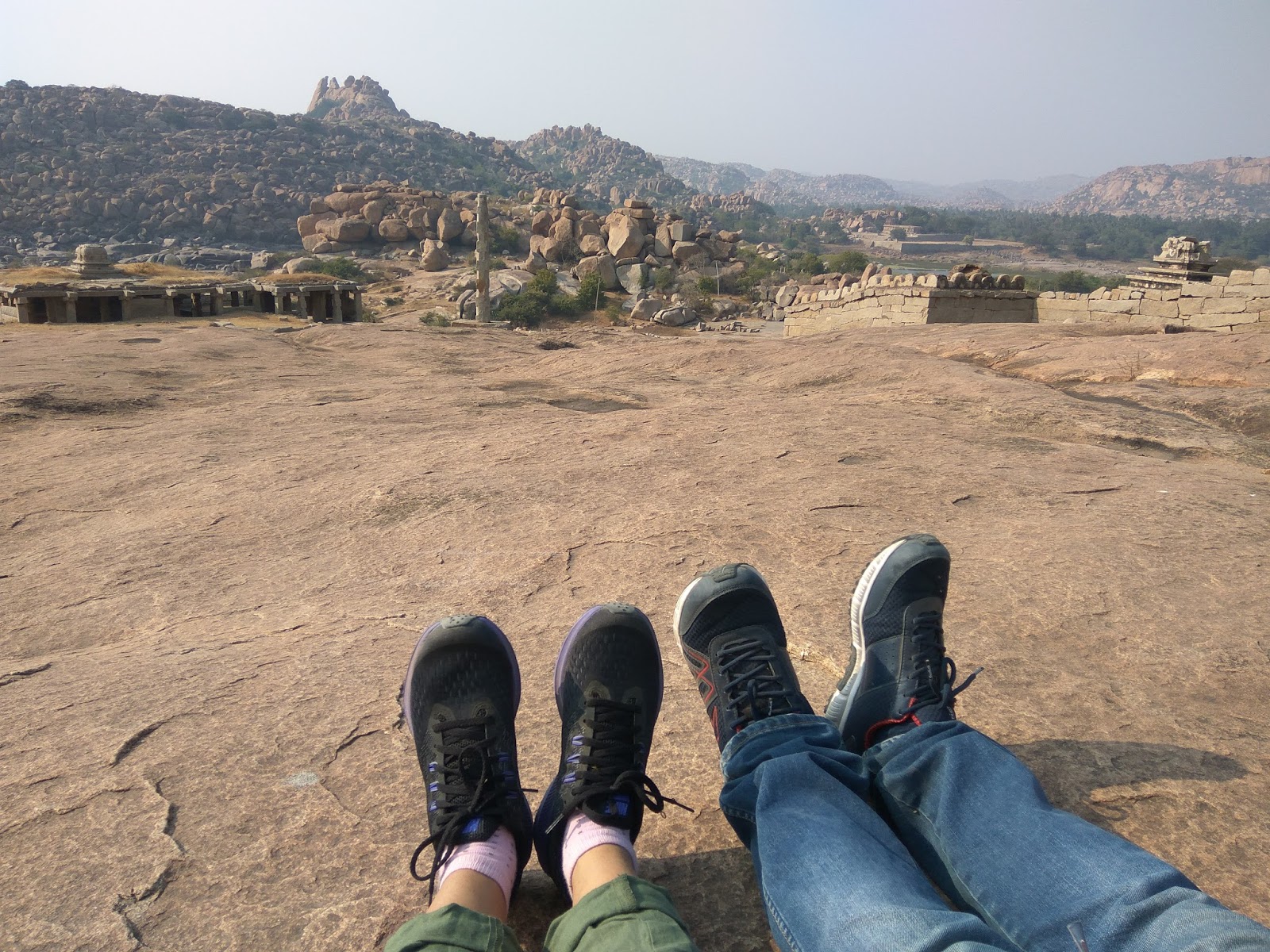
This was the road, once upon a time was busy with the ragged sounds of chariots, bull carts. We took a left and start walking by the mountains, with Tungabhadra river on our left and rough, brown mountains on our right. These mountains could be merciless during summer. But fortunately we went to Hampi in winter, in January, according to me the ideal time. But even if it was winter I did not forget to slather myself with ample amount of sunscreen (to his absolute wide eyed horror)! While on this practical topic, I should mention, you need a really good pairs of sturdy shoes, and ultimate comfortable cloths, preferably linens, cottons. And most important- water. But at night during winter Hampi gets really chilly, be prepared for that too. 


The Tungabhadra was beautiful like a landscape painting. There was patches of land-form in the river bed, rocks, emerald green shrubs. It was like some other kind of ecosystem. Also there one could see ruins of a bridge in the river-bed, the most unusual thing I've ever seen in my life.

Trek along the banks of Tungabhadra

Trek trails captured from South bank with visible ruins on North bank

From the time we started our little hike with Tungabhadra on our left and the rocky mountain on our right till Vittala temple we came across few more residues of the old Hampi that still managed to hold their ground against the tide of time.




Carvings along the trek trail

There has to be a Courtesan street in every city irrespective of different era, empire, epoch or empathy! The oldest profession of the world always needs its own street. Hampi is no different. Again my imagination ran wild. I saw Uppamala standing there waiting for the next one, wondering whether he was going to ask for the girlfriend experience and in exchange she was to have a boyfriend experience, fake but worthy.

Achyutaraya Temple & Courtesan's Street

Then we came to King's Balance. The balance was used to weigh the kings against the gems and golds on auspicious occasion, and here I was thinking it symbolizes justice, silly me! 

The King's Balance
                         
After that we came across a ruined gate. The ornamentation on them reminded me of the border of  a sari, the ultimate Indian attire!


We came to Vittala temple and its Gopuram. The work of bricks on the upper half of the stone structure Gopuram looked like a later added structure. Still did not get any opportunity to check it with any historian.

One of the gates of Vittala Temple

In the courtyard of the Vittala temple was the stone Chariot. And there were high stages with 4 open sides standing erect with the help of the highly ornamented columns, the craftsmanship is breathtaking! I tried to give some dancing poses, but though my poses were great, my protruding paunch just ruined my otherwise gracious photographs!

The stone chariot in the courtyard of Vitthala Temple is synonymous with Hampi. It is an iconic symbol for everything Hampi stands for. The stone chariot is now on new ₹50 note.


The world Famous Stone Chariot
Inside Vittala Complex. Go see for yourself and tell me what you find.
The Musical Pillars at Vittala Temple - Try it to believe it

One of the greatest subject of awe and mystery is musical pillars in the Ranga Mandapa. They produce "saragam" when struck by hands. These narrow and hollow pillars are parts of a bigger column. What amazed me is the marriage of imagination and engineering and what one could achieve from that - stone made structure that produces music.

Experience it: Musical pillars at Vittala Temple complex

Next we headed for Elephant stable. Obviously elephants were like Lamborghini's BMW's for the ancient kings. The echoing massive structure surely made me feel like a Lilliput.

At Elephants Stable

The queens bath only raised one question in my mind, why was it so much away from queens residence? It has to be far, because I did not see any residing place nearby. 

Queen's Bath - Kamalapur

While coming back from Elephant stable, we saw the lotus temple. The structure's  similarity with a lotus is unmistakable.

Lotus Temple - Kamalapur

The Hajara Rama temple is a perfect example of how the sculptors used to tell stories through their chisel and hammer.


That evening we went to sunset point and while waited for the sun to set, vigorously indulge ourselves with right amount of vanity into selfie taking business. On our right side we had the pinnacle of the Virupaksha temple. Finally the sun decided to set with its full glory and mind boggling colors. In the background the "aarti" the evening worship of the god started. That melodious chanting, the setting sun wrapped us in a mystic trance.


Discover your very own sunset point. Backdrop of Virupaksha Temple
                             

Next day we again went back to Chariot street. It was calling to us! And do you know one thing, now in my mind I know I have to go back again again and again to Hampi, to the chariot street. On one end is Virupaksha temple, and on the other side at the end of chariot street is a gate, at the foot of the hill. There is also the monolithic bull or "Nandi". At that gate we sat for hours, forgetting our mundane woes. My advice - please do the same when you are in Hampi.

Group of pillars at Chariot Street

The dancers, the women sculpted on the walls of the structures would give anyone serious complex. But it would also give some new goals and motivation. My advice would be to go for it, it is only January, you have the whole year to achieve everything.

Sculpted beauties

We stayed at Kamalapur, at Hotel Mayura Bhuvaneshwari, Karnataka Tourism Dept. It is a good place to stay. The rooms are very comfortable and surrounded by a lush green garden.


The dining room is very cozy and at the same time had a very festive vibe to it. 

So when we reached Hampi, we came to know that there was a strike going on. Apparently the small cafe and sack owners around the Virupaksha temple, in the centre of Hampi have been asked to relocate. The government has decided to make the site as it was before all the commercialization. So, the small business owners' properties are going to be encroached by the govt. A good thought to retain and maintain the ambiance of a historical place. But it posits a serious threat to the livelihood of those people. But what I heard is there is a negotiation going on, and I hope all those property and business owners would be suitably compensated and rehabilitated. 


Hampi - Walking distance from Sun set point


This situation created a problem for us. Once we were out of the hotel which was few kilometers away from Hampi, what were we supposed to eat for lunch and etc. We could have packed something, but on our 1st day there we didn't know about the strike. So when we were searching for food helplessly, we found Geeta. Her family ran a cafe, and secretly taking in few customers. We went in, sat behind a huge refrigerator, and ordered egg and vegetable sandwiches and also tea, as they didn't have coffee or milk. It was freaking scrumptious. There was a book self. It had books of all possible languages on earth. Found a french Agatha Christie there too. Unthinkable! Geeta took really good care of us. Next 2 days we had lunch there. In a word she saved us.


The day we were coming back, our train was at 9:05 pm. So we decided to go to see another sunset,  but this time over Tungabhadra dam. No need to say anything, see the photo.

Sunset at Hospet - Tungabhadra Dam


How to go:
Trains are available to Hospet Jn (HPT). Buses are available from morning to late evening from Hospet to Hampi.

Where to Stay: Hampi, Hospet or you can stay across the river too. (ferry services available till 5 pm)

Best time to visit: November - February


Recommendations:  You should plan a minimum of 3 nights and 4 days stay.
Day 1 - Kamalapura (major attractions: Lotus Mahal, Elephant Stable, Guards Quarters, Ranga Temple, Hajara Rama Temple, Pan supari Bazar, Queens Bath, Prasanna Virupaksha (Underground Shiva Temple), Stepped Tank

Day 2 - follow trek trails along the banks of the Tungabhadra from Hampi to Vittala Temple (2.5 kms) through King's Balance, Courtesan's Bazar, Varaha Temple and return to Hampi to enjoy the sunset at Sunset point. A visit to Virupaksha Temple complex after sunset is recommended.


Day 3 - Cross the river and enjoy the greenery and scenic beauty along with a few ruins. 


Day 4 - Tungabhadra dam (locals refer it as TB Dam) & light house view point, T B Dam Zoo & Park with light and sound shows after sunset (Buses are available from Hospet to TB Dam)


*Bikes and cycles are available for rent in Hampi on both North and South banks of the river.

*Mobile network weak in Hampi
*No non-veg, no alcohol at Hampi


-----     Leave you queries in the comments below     -----


Friday, 19 January 2018

Poor Man's Purple Passage

What the fudge they mean when people write this type things with lots of periods and exclamation marks and hiphens?

The quintessential existence of the harbinger.....melodious soul is lurking at horizon.......listening to the harmonious predicament of the övre for the pulchritude........the horizon where sky and azure ocean meet ------ in the midst of it the fey thinking man of Michelangelo and the vitriolic man of Da Vinci pondering over in their otium?!?! The insouciance of the black hole creating chasm over the flora and fauna.....the id...ego...super ego....in the fjord like a faberge egg...the encrusted bitter-sweet surrealism of paleolithic age coming on the top of a pyramid in city of dead's having a tête-à-tête with Anubis and Ra...the voyage from Tesla to Elon Musk...the Lincoln in the Bardo or A Little Life...who killed Versace...it seems devil most of the time wears flip-flops... tweaking with Chaucer's Wife of Bath in front of Coriolanus seems not so a distant dream now....through all these meaning of life and of depression unveil itself.

Yes, what do they mean? Actually it is the most clever and convenient way to portray oneself as an knowledgeable intellectual! But this passage is just a silly write up that can not even be termed as a "purple passage". See what I did there!? I told you very shrewdly and I think quite subtly that I know the term "purple passage" of Horace. And did it again! Peace out!!

Sunday, 17 December 2017

Shakespeare to Shakira


People love to categorize. Put everything in a box and then label it. It gives them peace of mind. Yes, we have figured it out. Hurray! Problem arises when one cannot find a category, a label for someone, something. There are some fixed idea about things that people do not like to toy with. But nature takes its own course and forms people's mind with all the possible unexpectedness.

If a person is good at studies, it is taken that he or she would be a very serious grave person. Same goes with intelligent people or intellectuals. A PhD scholar or a Maupassant-Maugham or a Rilke-Baudelaire or a Monet-Matis or a Bach-Beethoven or Camus-Kafka-Kundera or a Chopin-Puccini fanatic is not supposed to dance at the pub drunk listening to Bailando, less twerking to get your freak on. But he can. He does.

A doctor or a physics professor can be a religious person who never forgets to pray in front of his gods, and at the same time keeps an eye on the television because soon Skyfall is going to start. A Muslim could be a vegetarian. He could hate meat. And when everyone is eating supposedly forbidden meat wraps he could go for simple grill cheese sandwiches. He shyly requests his quite capable and over qualified but otherwise sickeningly lazy unambitious wife to get a job as people start to whisper that he being a Muslim is against the idea of women working. On the other hand it can also happen that a knowledgeable person with all his wisdom decides to a stay home and not do anything. 

Someone who loves to cook all the time starts to discuss for hours about Browning or Keats or Donne or Virginia Woolf people get shocked. And if then he starts to talk about the gory violent thrillers of John Sandford, Steig Larsson, Val McDermid people get shocked. If you know about Chaucer is it a rule that you cannot know how to make a fantabulous chutney! If you are a CEO of your company that means you cannot twerk like Miley Cyrus! (It seems twerking is becoming a recurrent motif of this piece of writing). A person who is talking ardently about Shakespeare, if he is seen talking about Shakira with same fervour people feel like they have been cheated. They give this look like they are saying "we are told and made to believe that you are gonna and only can talk about Shakespeare, and here you are also talking about Shakira, we have been conned to believe you are only this person, but no you are actually that person, too"!

Friday, 8 December 2017

Sylvia Plath Wanted to Live


Sylvia Plath wanted to live. She gave hints in her writings, through her words, through her actions. Nobody took that hint. Nobody read her words, I mean "read" read! She wrote about resurrection in Lady Lazarus, she talked about Phoenix, Lazarus. If all she wanted to do was to die, then why she kept talking about rebirth that only means life! 

She tried to kill herself several times. Once when she was not able to meet poet Dylan Thomas, around that time she slashed her legs to see whether she had the courage to kill herself. Next in 1953 August 24th she took her mother's sleeping pills and crawled in the cellar. She was found later and survived but admitted of having an oblivion that could only be compared to death. Then in 1962 June she drove off a road into the river but was rescued and told it was her intention to kill herself. Then came 11th February, 1963, Plath put her head into the gas oven and finally succeeded. 

The responsible mother in her did not forget to put tapes, clothes, towels between her suicide zone and her kids' room, unlike Assia Wevill, Plath's husband Ted Hughes, the Noble Laureate's mistress who killed herself and her daughter Shura. I bet during their togetherness Hughes accused Plath of being irresponsible. He had to, because all husbands of this world accuse their wives who are depressed and have the tendency of self-harm to be irresponsible because during chronic clinical depression people lose the desire, the ability to perform the simplest of thing like brushing their teeth or combing their hair or the desire to go to work. In depression people do not even feel like having a job. Sylvia Plath was a brilliant student, a Fulbright Scholar with a high IQ of 160 and she worked as a receptionist for god's sake! But she proved herself to be a good mother and a good writer. That was enough for me. 

But she was not good at being alive. She wanted somebody to take care of her. Her poems, her only novel Bell Jar told people she was in pain, she was unhappy. Why people did not try to ease her pain? Why people did not try to make her happy? Isn't it that simple? Isn't it supposed to be that simple? If someone tells me she is thirsty, I give her a glass of water, if somebody says he fell down and scratched his knees I give him a band-aid. Yes, it was that simple. If somebody on regular interval try to kill herself I will see to that that she do not do that again. Simple. But people are generally callous. People are so engrossed with little problems of life like the favorite newspaper changed its font size, yesterday's milk got sour, sound of loud crying hampers family's reputation, friends are going to Italy for vacation, they have a better car, better make of a juice maker, stock market is crashing, diamond is not a Solitaire, anxiety of showing happiness of being in love in front of the single friends or brothers or an itchy scalp that they forget once a life is gone, its Gone. "Gone", the implication, the true meaning of this word nobody gets. If they did Sylvia Plath would have lived a full happy life with few more Pulitzer's or may be a Nobel in her pocket!

Sometimes depressed people cling to a person, if they find someone they think they like or love, they get very attached to them. This unnatural attachment or one can call it love seems to others as a sick desperation, an unhealthy clinginess, a ridiculous neediness. Plath's agitation and anger for not being able to meet Dylan Thomas whom she loved "more than life itself" as some said proves the intensity of her character. Soon after she slashed her legs. Later when she met and fell in love with Ted Hughes, she described him as "a singer, story-teller, lion and world-wanderer" with "a voice like the thunder of God". This comparison with God proves her intensity of emotion, the depth of her attachment. Having all these emotions for him, giving the ultimate compliment to the man and putting him on dais to worship is a typical tendency of someone who has no hope, no desire but suddenly getting a rope in turbulent sea to hold tightly, the saviour is here. But sometimes the grip on that rope gets so tight that the supposedly knight in shining armour feels suffocated and runs to Assia Wevill. Even a free single unthwarted man goes to so many, and here I am talking about the husband of probably the most depressed woman of the literary world desperately seeking love and care. Sylvia Plath's father left her, okay he died, and she interpreted it as abandonment. So when she loved someone, she demanded the whole. She thought this man will take away her sorrows, will fill her soul with saturated overflowing care and love. Did she get it? Who has the time to cater to an insomniac, suicidal, temperamental, generally sad person! 

Plath's son hanged himself. So it is easy to say it was genetic. Insanity, depression run in the family. If the women are depressed during pregnancy, there is a fair chance her children would be depressed too. But here one must note one thing, Ted Hughes' wife, mistress and his son committed suicide. Okay, I know Sylvia Plath have contemplated suicide years before meeting Hughes. Maybe it was her, she turned everything blue she came in contact with. But her daughter who looks like her is the lover of life. She once told a journalist that the death of her loved ones made her embrace life all the more. Okay, I get it, she got this beautiful positive demeanor from her father maybe. So, when I asked who to blame for the death of Sylvia Plath, some said nobody to blame, she was mentally unwell, she was bound to kill herself sooner or later. Maybe. But why cannot I come to terms with this fact! Why I feel that all she needed was over the top melodramatic stupid romantic love, I will bring the moon for you to see you smile like devotion, for each of your tears I will give you a pearl like care!

Saturday, 2 December 2017

The Ministry of Utmost Happiness - A Review


I read God of Small Things by Arundhati Roy when I was in high school. I was bewitched and speechless. In the mean time gallons of dirty water passed through my city's drains, and during my travel through the decades I forgot her. She came in conversations from time to time, but she became a distant memory. Then bam! it came, The Ministry of Utmost Happiness. So I read it. It was in the Man Booker Prize nomination. People were asking me whether it's going to win, I said "yes", and then "no", okay I could not decide. Then George Saunders won Man Booker for "Lincoln in the Bardo".

I "liked" the book, it made me remember why I "loved" God of Small Things. That fluid poetic music of sadness glides by so smoothly in GoST,  one cannot stop it, can just experience it. The feeling I had in GoST is exactly like the one I once had in my uncle's house. I was looking at the palm tree from the 2nd floor room lying in bed. Windows were open, a breeze was coming that comes only just before the winter, somewhere the sun was setting. And that twilight aura engulping my mind. You want to look away as you do not want to cry, but you cannot move. That's the feeling I got from GoST.  Ministry... was preparing to do the same to me, it even did for few hours, and then came politics. 


The story started with Anjum. Sorry. The story started with how the use of Diclofenac in cattle is killing vulturs in India. And cattle is a recurrent motif in this novel. The very description of the dying vultures was a direct punch in the stomach. At least one drop of tear will fall uncontrollably, and you will realize you are crying when the tear will hit your jawbone, yes just like a very runny nose is runny your realize when it touches your lips! So in that prologue Arundhati Roy announced she is back, like the Terminator she kept her promise. I had goosebumps, oh by the way did I tell you how much I was moved by GoST! 

So Anjum was born, she was an eunuch. The time she was born in India, an eunuch could not do anything except be a "hijra", they could not be a makeup artist or a college professor, just a "hijra". There was a place near Lal Qilla where since Mughals, eunuchs were living. Once upon a time in India eunuchs always had a free roaming card to roam about in andarmahal or interior parts of castles where queens and princesses resided. That place near Lal Qila was called Kwabgah. Such a beautiful name this Khwabgah, almost like Elysium in As You Like It! But here lived the "hijras", the unwanted, the despicable them. Anjum started her life there, she went to a quack to chop off her ashamed male genitals, and never had an orgasm ever. But here the question was which situation was better, she having a male sexual organ and having a night fall but her heart, her mind felt ashamed of the fact that being a girl it was unnatural to have a fall? Or that to sooth her wounded mind, to unveil and acquire her true femininity she was to never have the happiness that is sometimes compared to being once again born or to meet god, a word that Roland Barthes used to describe the pleasure of reading? 

She went on living in Khwabgah, found a foundling, started raising her, that girl fell sick, here comes again a very striking situation when Anjum blames another Khwabgah mate for her daughter's illness as well as 9/11 in America. Now that is there a fine example of microcosm to macrocosm, mixing superstition with the huge  technology that involves a mass destruction, the ridiculous with the grave, the Fool with the Kings. 

Anjum's story involved the Godhra riot. Here Roy made her presence felt with her powerful pen, all the folding and unfolding of the men and women, not the eunuchs, thank god, or is it? Anjum was changed after this, started living in a graveyard, built the Jannat guesthouse and various people started to flock there. 

Tilo would come there too with a child, but that was to happen later. Tilo was another part of the story, she is clearly based on the author herself including her JNU connection and her hair to her nose pin et cetera et cetera. And with the author's shadow came all the other shadows, politics, a leading protester with her salt and pepper plait, gummy smile, big chested chaste man, the shivering national leader, heaven on earth turning into hell with their peach and cream complexion, the tribe with their black hue, and everything in between! And here starts my problem with the book. My views go with Pater, "art's for art's sake". If a novel becomes an agenda, it falls down in my eyes. Here in this novel there are pages that looks like essays that Roy was writing for last 20 years on various burning topics, some pages clarifies some of her actions and denies some allegations. These paragraphs even looked like what sometimes we write randomly with tremendous speed because we are angry. I truly believe because of Tilo's story the book sometimes lost its integrity as a novel. Still the delineation of Tilo's psychology is well observed and very personal, one can feel it. But trying to touch all the on going problems in the world in one book that ultimately intends to tell a "story" is too much. Even the dog they found had to be the runaway lab dog with all the pipes coming out of every holes of its body. Animal testing is a cruel ugly truth that needs its own novel and a revolution. But why I felt as if the author was running out of time, she was in a hurry so she put everything she thought of in one book? Is there no such thing as editing of thoughts? If Roy had written only Anjum's story it would have been great in itself. Tilo's story seemed an intrusion into the beautiful narrative of Anjum. It seemed Anjum and Tilo were written by two different authors. And there lies Arundhati Roy's ability actually. So as a reader I'm looking forward to more stories like Anjum's in future. Please. 

Lastly, the title of the book, The Ministry of Utmost Happiness, bound to make one ponder over its origin.

Goa, India

Goa was not ticked off my list yet, FOMO got to me and we planned to visit Goa. We stayed at Goa tourism guest house. It was a mode...